
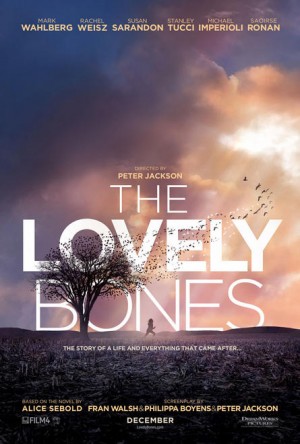
First of all, I haven’t read the 2002 novel of the same name on which this movie is based. Now I wish that I had, since I’m having trouble understanding how a book that sold millions of copies could be the basis for a movie that flounders primarily in the construction of its story.
Actually, it’s not that hard to understand. Movies often (though not always) work best when they have straightforward story lines involving characters with clear motivations and goals. “Bones” director Peter Jackson’s best-known work, the “Lord of the Rings” series, is a great example of this: The Fellowship has to destroy the Ring before the evil Sauron takes over their world. Either they’ll succeed or they’ll fail. Their quest is the driving force behind everything that happens in the plot.
By contrast, novels often focus more on characters’ internal thoughts and emotions than on external events. “Bones” the book, by author Alice Sebold, takes this tendency to a whole new level by assuming the point of view of a dead person–specifically Susie Salmon (played by Saoirse Ronan in the film), a 1970s small-town teenager who is raped and murdered in the first chapter. The rest of the novel consists of Susie observing from Heaven (or some pre-Heaven purgatorial place) how her death has affected the people she left behind. She can occasionally interact with the living through basic supernatural gestures, but for the most part she can’t really do anything. This presents one hell of a storytelling challenge: What do you do when your protagonist isn’t really a part of your story?
I’m not qualified to say how well the book handles this issue, but the movie is never able to decide what exactly it’s supposed to be about. Is it about Susie’s journey through the afterlife? Not really. We get a lot of psychedelic, CGI-based visions of what the Beyond is like for her–giant ice sculptures, tiny planets and wacky disco fantasies are all invoked–but nothing much really happens up there. Is it about a quest to bring Susie’s killer, middle-aged neighbor Mr. Harvey (Stanley Tucci) to justice? It seems to be, for a while, but Harvey’s storyline trails off at the end before being sloppily concluded in one unintentionally hilarious scene.
Susie’s closing narration claims that the story was really about the metaphorical “lovely bones,” i.e., the relationships that grew up between her family and friends after her passing. That’s probably what the film should have been about, but the sections focusing on the afterlife and on Mr. Harvey take up so much space that the sympathetic supporting characters (and, to some extent, Susie herself) get reduced to comic-strip cliches. Mark Wahlberg plays the loving father with a conveniently symbolic hobby of building miniature ships. Susan Sarandon plays the spunky grandmother who knows what’s best in the end. Perhaps the most artificial out of the bunch is Susie’s love interest, Ray (Reece Ritchie), a handsome high school senior with a sexy British accent. Ray tells Susie how beautiful she is in their first conversation, which is apparently supposed to be endearing rather than creepy and bizarre.
Jackson is an immensely talented filmmaker, and his command of cinematic technique keeps things compelling even when the narrative doesn’t really work. The cinematography is beautiful, and sound is used especially well to transition between the real world and the afterlife. Ironically, it’s the screenplay–the film’s foundational “bones,” if you will–that’s lacking.
Also, between this and “Avatar,” movie fantasy landscapes are starting to look more and more like Lisa Frank illustrations, and I’m not sure that that’s a good thing.

I read the book years ago back in high school, and don’t plan on reading it again or seeing the movie, but from what you’ve said it looks like they changed a fair amount from the book to make a more movie-like script.
I always imagined Susie’s character like Mary Alice from Desperate Housewives, a disembodied voice through which we can be a fly on the wall into the living characters’ lives. It seems like in order to cater to a more family-friendly audience, they made her role a much bigger personal exploration, which would definitely detract from the independent observations she presents in the novel.
Also, from what Wikipedia is telling me, the movie is definitely sugar-coated to be a more heartwarming film, completely omitting the gruesome and creepy depiction of Susie’s rape and murder. More violence and sex is also omitted from the film, and Susie’s child-like innocence is retained–in the book, Susie descends to earth not to kiss Ray, but to have sex with him.
It’s a great book and I recommend reading it, but leave the bad taste of the movie out of it. And I agree with you on the Lisa Frank thing…I half-expected a white Siberian tiger to pop out of a rainbow in Susie’s shiny heaven during the trailers.
Nice review, Matt. Thanks for confirming my doubts about the film.