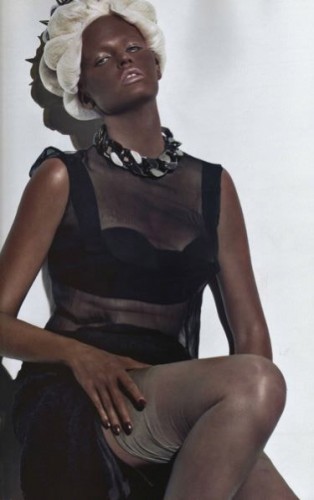
Last month, I opened my March issue of Vogue magazine and came across an advertisement featuring models in blackface. Frankly, I was taken aback. As a black woman, I was offended, and I’m not the only one.
In recent months, the fashion industry has seen a rise in the trend of using blackface in magazine spreads. White models are caked in dark makeup to make them appear darker skinned. It began when Lara Stone posed in blackface in Paris Vogue and continued when Tyra Banks painted her competing models in cycle 13 of ANTM in dark makeup to change their ethnicities. Happily it seemed to ebb away after Sasha Pivovarova posed in blackface with Heidi Mount in V magazine. While proprietors of the trend insist that it is a creative decision meant to push the boundaries of fashion, sane-minded individuals maintain that the historical implications of blackface prevent the practice from being anything but offensive.
There are also the obvious questions that arise in a situation like this: If you want a darker skinned model, why not HIRE a darker skinned model? And though Italian Vogue has made a bold move by launching it’s new site Vogue Black to highlight black talent in the industry, fashion magazines continue to be devoid of faces of color.
International supermodel Naomi Campbell has publicly claimed that the fashion industry is an institution that remains prejudiced against African Americans and other people of color. She believes that the recession has made the situation worse, and that now advertisers are wary of using ethnic models in their campaigns for fear of economic backlash.
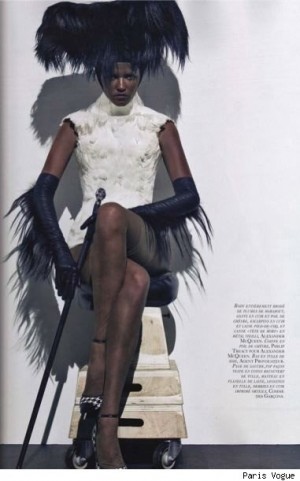
While some people don’t see the reason for the fuss (it is just a picture after all…) the fact remains that since its debut on the cultural spectrum, blackface has become synonymous with racism and racial prejudice. The very idea of blackface carries stereotypes about African-American people and their culture that still persist today, even though the practice had been all but eradicated by the end of the 19th century. Blackface mocks the progress that people of African descent have been able to make over the last century by rehashing the negative way in which they used to be portrayed. People of other ethnicities do not appreciate being mocked for the stereotypes that have developed about them, so why should this be any different?
No matter which way you spin it, blackface has too many negative connotations to be anything other than offensive. But of course that’s just my opinion. Obviously I’m biased.

Extremely well-written and compelling. I took a class on the sociology of sex and gender last semester with Ashley Mears, who did her dissertation on the fashion industry, and we discussed how not only are African-Americans underrepresented in the fashion industry, but when they are represented, they are most often portrayed either as savage and animalistic, in camouflage and animal prints with wild-looking hair, or as exotically as possible. It truly is an issue and this blackface thing really disturbs me even further.
Can we see more editorials of this calibre, Quad?
Devon, you’re completely right. I didn’t even touch on the way that African Americans WERE being portrayed. There was a spread with Naomi campbell in harper’s bazar last year that had her running next to a cheetah and playing double dutch with monkeys while a white guy looked on:
http://sandrarose.com/2009/08/13/is-harper-bazaars-naomi-campbell-fashion-spread-racist/
the fashion industry has trained us to think of all non-whites as exotic, and only represent them in that context.
I am also a black woman, but I think you’re taking this far too seriously. I think blackface is not something to be offended about, simply because some people used it to mock blacks before any of us were born. It has great value as an art form and breaks down the concept of race. I respect Vogue for having the guts to use this art form despite the carping of overanxious blacks.
Theresa I’m afraid I’ll have to disagree. I love fashion, and I support the fashion industry, but what people are failing to realize is that blackface is offensive in the same way that a swastika is offensive and ALWAYS WILL BE OFFENSIVE. it represents a dark time in human history, and no matter what you do, or how good your intentions are, the practice is disrespectful to those who have suffered because of it.