
F/X’s big midseason drama “Lights Out” is tough and riddled with potential, but has yet to overcome uneven execution.
The show winds around former heavyweight champion of the world, Patrick “Lights” Leary, played with restrained savagery by Holt McCallany. McCallany has the hulk of a fighter/way way tough guy gone to seed: formidable despite the absence of athleticism. We come upon Lights ten years after he’s lost his title, and the man is making pancakes (though to be fair, the series opens on Lights’s face beaten into a grotesque, purple pulp, which very much elicits an “oh snap” viewer response). The day goes on and Lights heads to the darkly lit boxing gym he owns, fast action editing shows us flashes of an old fight, then Lights sits in his car, another snap edit, night has fallen. Lights is either insane or there’s something not so subtly implied here.
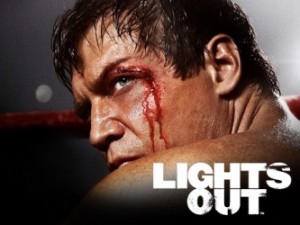
The something as it were, is pugilistic dementia or Chronic Traumatic Encephalopathy. CTE is a neurological disease cousin of Alzheimer’s caused by repetitive and prolonged blows to the head. This premise, a television show about an ex-boxer with dementia, is fantastic, but the “Lights Out” writing department seems genuinely unsure of how to incorporate the disease without sporadic use of jarring, inelegant editing.
Fortunately (or unfortunately), CTE takes a back burner for most of the pilot, as it has for the series thus far. Fear not, another interesting plot prong emerges when Lights learns from his brother/manager/hypeman that the money is gone. So, the champ makes celebrity appearances like reading bingo balls for old people, lies to his wife, panics stoically like a Hemmingway man, and then agrees to go “collect” 50,000 dollars from a dentist in Jersey. Now, “Lights Out” is not about the boxer, but the family man. “Lights Out” is about desperation—the end.
This development engages the viewer. The train’s leaving, we’re on board, maybe we expected some actual boxing, ringside grittiness, but we can get down with Lights and his unraveling life. He’s a man who spent his life slugging out money and wellbeing from the brow of another. If he goes down, he’ll hit the floor like a truck.
Another positive: none of the characters on “Lights Out” feel particularly sympathetic, which acts as an interesting extension of fighter’s bravado. The show puts forth a cool impudence in this way.
Therefore, what’s largely wrong with “Lights Out” is confusion. Not what the hell is going on, but what the hell are you trying to say? Creative ambition has set up too many contradictions. Lights has CTE, but he doesn’t care. Lights wants to save his family, but he doesn’t want to be a thug. Lights could box again, but his wife would leave him. He’s a good guy and he’s an animal. Sure, these pieces all feel true to life, one person could plausibly struggle with many more issues, but this is TV. Strife feeds strife. Disparate conflict weakens the conflict itself. Uneven execution may just mean disjointed writing that leads to muddled acting, or put even more simply the problem is a lack of story focus impeding audience investment.
The show will air its sixth episode this Tuesday. Get it together, Lights.

Had to reply to this article because I totally disagee..From where I sit, as someone who has followed the deveopment of this show since the very beginning, my take says it’s not confusion that is the problem, nor is it “‘bad writing” or anything else you list. Bottom line, it just shows me how “dumbed down” most tv viewers have become. If you don’t come flying out of the gate in the first ep with some jawdropping event (in drama) , they aren’t satisfied. Laying out your characters and building from there, as is (or was) typical for a serialized drama is no longer appreciated, you must give them everything, right now this minute! and that’s NOT the way Lights Out is written. And that was not a mistake IMO, had this show been on HBO or Showtime, where people PAY for premium tv, the reaction would have been very very different. I give FX all the credit in the world for putting this show out there, but cable viewers have changed and very quickly I might add. Put that all together and stick this show on a night and time slot that has MORE competition than ANY other night of the week, and sadly you get the results we’ve seen. Not many even gave this show a chance and when we lose a gem like Lights Out, I think we need to look at ourselves and not the show to find out WHY?? But, we don’t have time for that now do we, Jersey Shore and The Real Housewives of fill in the blank, and the pregnant teenagers. and the 25th cop show and the18th lawyer show well we can’t miss THOSE shows now can we? Oh and now we have the vampires too, whew forgot about them………..
This article is crap, and your reply is spot on. How care there be any confusion. When the show first started it was a little bit all over the place, but it has come into it’s own. Each episode gets better. I completely agree with you on viewers today. People are not patient enough and shows like this will never get credit.